Search This Blog

Showing posts with label Shawnee. Show all posts

Sunday, March 25, 2018

Fort Recovery and the Battle of the Wabash


Fort Recovery, Ohio is a small town located near the head waters of the Wabash River. The center of town boasts a towering obelisk as well as a partial reconstructed fort. The town itself has only a few stop lights and a population of less than 1500 but it is a place of much historical significance. Unfortunately most people have never heard of the town or its history.

If you ask people to name the worst defeats ever handed down to an American fighting force, you will most likely hear them mention Custer’s last stand at the Battle of Little Bighorn or the 1812 invasion of Canada. You may even hear them suggest that the Texan defeat at the Alamo is the worst. What you are probably not going to hear mentioned is St Clair’s defeat at the Battle of the Wabash....but.... Why would you? Most history books and nearly all history classes skip right over this significant battle in United States history.
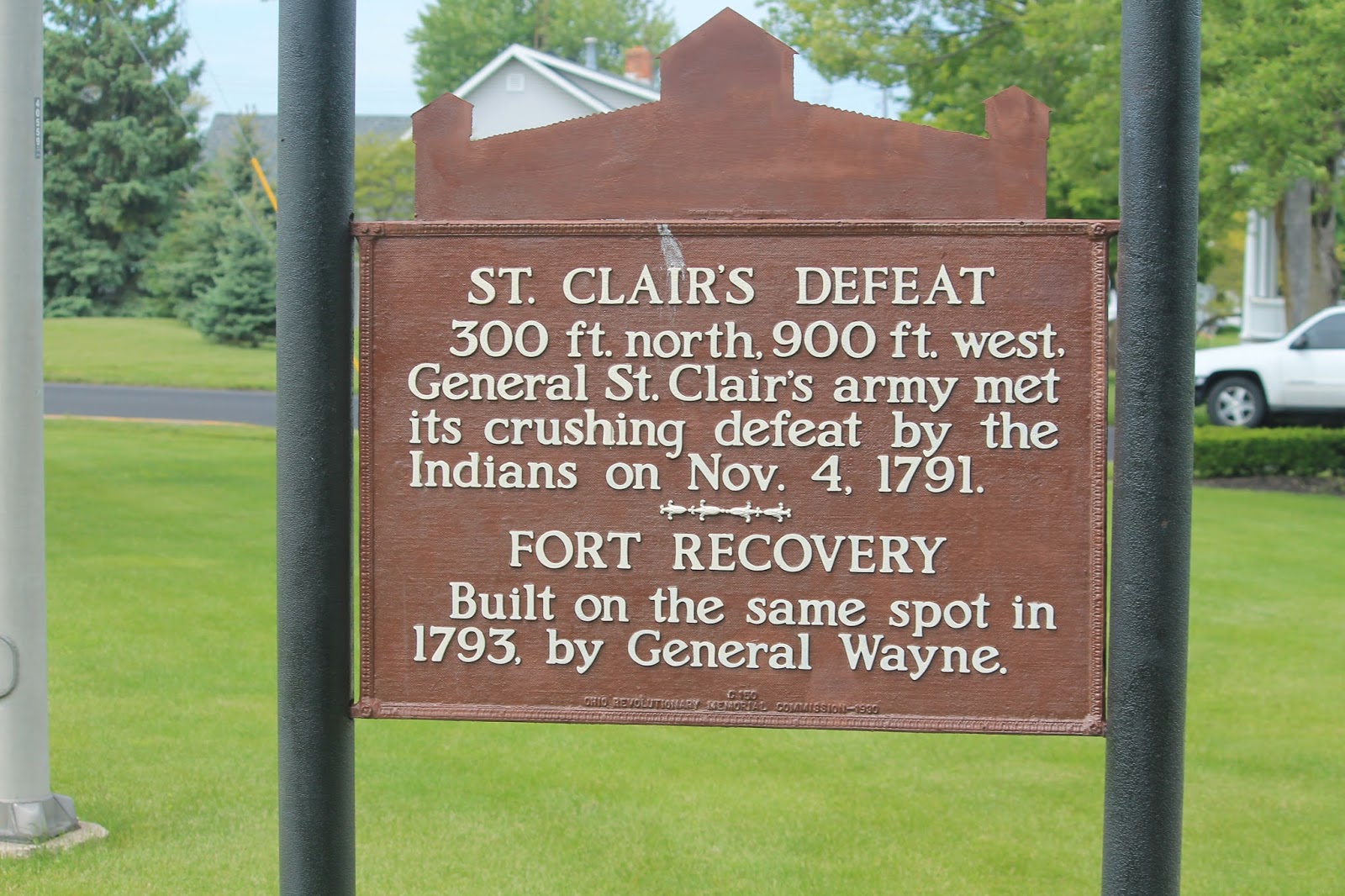
The Battle of the Wabash took place on a triangle stretch of land near the head waters of the Wabash River in present day Fort Recovery, Ohio. The battle was the largest confrontation between Native Americans and the United States Army and it was also the largest defeat ever suffered by the United States Army. 900 of the roughly 1200 American soldiers met their fate at this battle. In total 25% of the entire American Army was decimated at the hands of the nearly 1500 native warriors. [1]
Why did the war happen?
After the American Revolutionary War the newly formed American nation was deeply in dept and needed to raise money to survive. Under the authority of the Treaty of Paris the government planned to raise money by selling the newly acquired land within the Northwest Territory. That idea sounds non hostile enough but there was a major problem with that idea. The Northwest Territory was Indian country and the Native American inhabitants who lived there were not part of the Treaty of Paris and they had no desire to give their land to the American invaders. As a result of settler expansion, tribes living northwest of the Ohio River decided to band together in defense of their land and form what was called the Western Indian Confederation. [2]
The Confederation was led by Chief Little Turtle of the Miamis, Chief Blue Jacket of the Shawnees and Chief Buckongahelas of the Delaware Indians. Blackhoof, Tecumseh and his brother the Prophet were all members of the Confederation and all were reported to have fought during the Battle of the Wabash.
    
Cheif Little Turtle
Cheif Blue Jacket

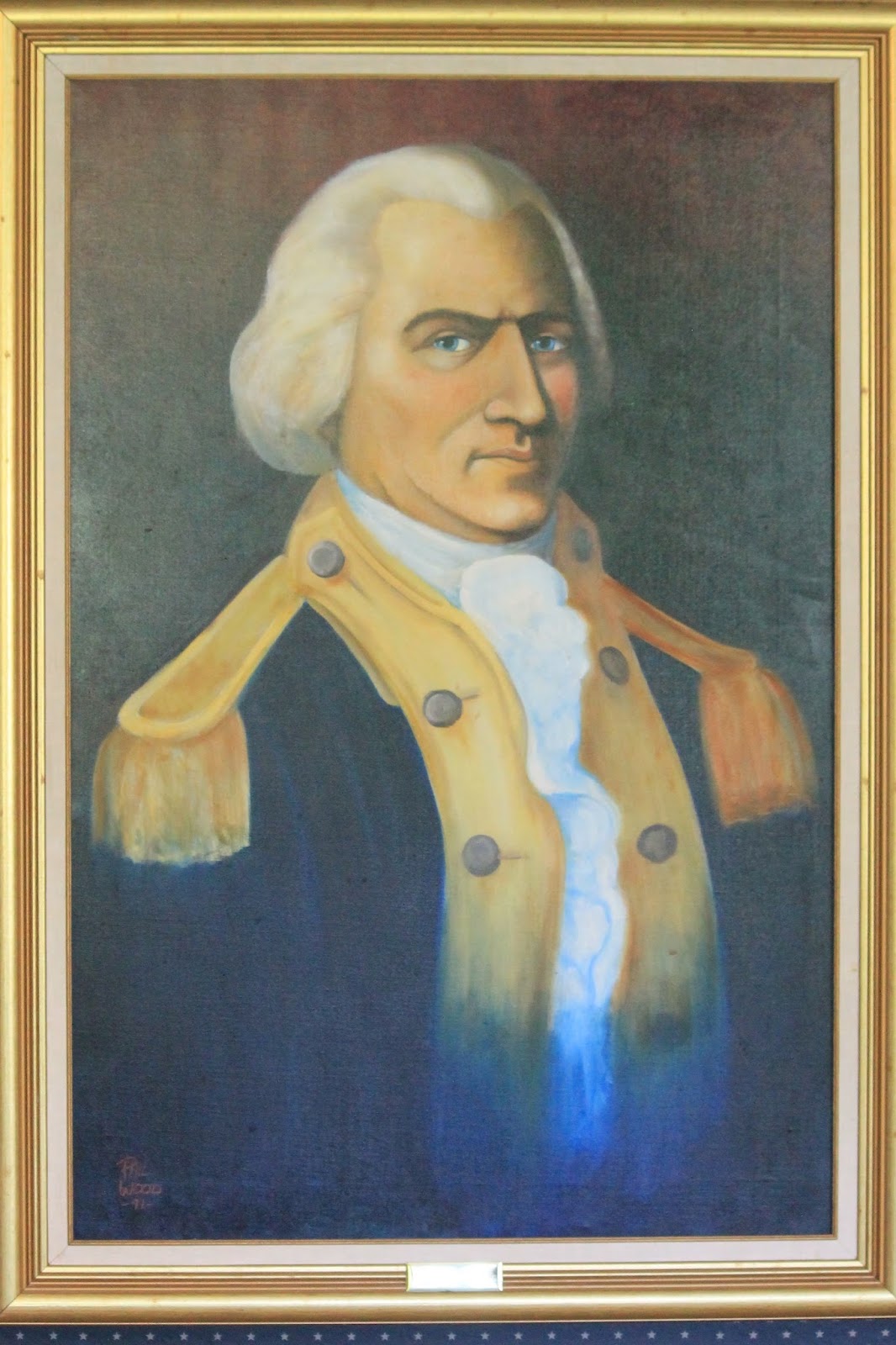
General St. Clair
  

 Under the orders of President George Washington General Arthur St. Clair had undertook a campaign to rid the greater Ohio valley of all its native inhabitants. Roughly 1200 soldiers and 250 civilians had set up camp near the head waters of the Wabash River. On November 4th 1791 the first attack took place. Led by Chief Little Turtle the first attack came so swiftly that several of the American fighters fled in panic without even so much as grabbing their guns. By the time the others readied themselves for battle Little Turtle’s forces had already surrounding them. St Clair, with his cannons positioned in a clearing on the high ground; ordered them to fire at the attacking natives. However, unbeknown to him, Chief Blue Jacket had positioned his Shawnee marksmen to take them out as soon as they were wheeled into position. Tecumseh and his band of Indian scouts had been tracking and watching the movement of St. Clair’s men for days. The Native attackers were very well prepared and they knew the lay of the land.
The battle raged for three long hours. In total 920 American soldiers and nearly 100 civilians were killed compared to the meager 21 Confederation warriors lost. Severely wounded and in a final charge General St Clair managed to escape with an estimated 200 soldiers and civilians but the battle was a near total annihilation and a massive blow for the United States military.

St Clair Monument
St. Clair statue


                                                                                             The Aftermath

           In the wake of the crushing defeat General St Clair resigned his commission and returned to the less dangerous role of Governor of the Ohio Territory. As a result of the Battle of the Wabash, congress passed two militia acts; one required that all able bodied men sign up for active duty in their state militias and the second granted the President the power to call upon those militias to fight on behalf of the United States.[3]
Under his new found authority President Washington ordered that the army be enlarged and within the year he had nearly doubled the previous size of the units under the command of General “Mad Dog” Anthony Wayne. In 1793 General Wayne sent 8 infantry units along with artillery to the very sight of St. Clair’s defeat. Wayne ordered the construction and fortification of Fort Recovery.
Fort Recovery
In the coming months native skirmishes and raids were attempted but the Confederation was now out manned and out gunned. The surrounding tribes would never again find victory at the site and were forced to withdraw and flee the area.[4]
Greenville Treaty Line Marker
 In 1794 Wayne put an end to the Western Confederacy when his much larger and well trained army won a decisive victory over the Confederacy on the banks of the Maumee River during the Battle of Fallen Timbers. One year later the Treaty of Greenville was signed and the once power Western Indian Confederacy was forced to relinquish all claims to land south and east of the Greenville treaty line. Native inhabitants living within Ohio and Indiana found themselves unwelcome on their own homeland and in grave danger if they stayed.[5]
The irony of The Battle of the Wabash is that it stands as Americas worst defeat at the hands of the Native Americans but because of that defeat the battle also stands as the call to arms that would lead to a national military and near genocidal results for the Native inhabitants of the Northwest Territory.


[1] Winkler, John F. Wabash 1791: St Clair’s defeat. Bloomsbury Publishing, 2011
[2] See Winkler and Eid, Leroy V. "American Indian military leadership: St. Clair's 1791 defeat." The Journal of Military History 57, no. 1 (1993): 71.
[3] "1792 Militia Act establishes conscription under federal law." 2009. https://www.history.com/this-day-in-history/militia-act-establishes-conscription-under-federal-law.
[4] Hurt, R. Douglas. The Ohio Frontier: Crucible of the Old Northwest, 1720-1830. Bloomington, IN: Indiana University Press, 1996 
[5] Pratt, G. Michael. "The Battle of Fallen Timbers: An Eyewitness Perspective." Northwest Ohio Quarterly 67 (1995): 4-34. and Sugden, John. Blue Jacket: Warrior of the Shawnees. Lincoln: University of Nebraska Press, 2000.


Tuesday, August 29, 2017

Cheif Blackhoof of the Wapakoneta Shawnee

One of my favorite things about studying history is that it provides the opportunity to discover people, places and stories that would otherwise go unnoticed by the average person. The story of Chief Blackhoof is one of those stories that is all but forgotten in popular history but is none - the - less, a significant story within the creation and colonization of the United States.
Very little is written about the life and times of the last Great Shawnee leader but what is known is that Chief Blackhoof’s story cannot be told without including the legends as well as the struggles.
The beginning of the French and Indian War also known as the Seven Year War.
In the morning hours of July 9, 1755 General Edward Braddock led a British force of about 1300 soldiers across the Monongahela River near present day Pittsburgh. The mission was part of a larger campaign waged by the British in an effort to force the French out of the gGreat Lakes Region. General Braddock’s mission was to secure the surrender of the French Fort Duquesne. After crossing the river with little opposition Braddock and his army set there sights on Fort Duquesne. Suddenly Braddock found himself surrounded by a force of nearly 900 Native American warriors. Braddock’s force became quickly overwhelmed and chaos ensued. By the end of the day Braddock had suffered the worst Indian defeat in British history. Braddock himself, ended up dyeing from the wounds suffered during the battle that has been simply termed, “Braddock’s defeat”. The future Shawnee chief Blackhoof was one of the warriors who defended Fort Duquesne and future American President George Washington was one of surviving members of Braddock’s army. 
                                        The Legend of Bulletproof George
In the mist of the early morning  I raised my rifle at the invading pale face and fired a shot. My aim was true but the bullet somehow missed. I adjusted my aim so the face of the white man was directly in the path of my bullet and once again I fired. As if guided by the Great Spirit my bullet once again missed its mark. It was at that moment I knew that this man must be destined for great things. I lowered my rifle and allowed the man to pass unharmed. It was said that the jacket the white man was wearing was riddled with bullet holes yet the man escaped the battle unscathed and uninjured. Years later I had council with this same man. I was now the leader of my people and he was the leader of his.[2] We both had grown in wisdom as a result of the events that took place that day. I would later call this man a friend and an ally to my people.
Whether or not this interaction ever took place is a matter of debate among scholars and historians but what is agreed upon is that the story includes two very important figures in American History. George Washington the man who could not be shot and Blackhoof the Shawnee warrior who took the shots and told the story. For both of these men, the Battle at Monongahela River would set in motion a series of events that would guide the two towards a greater purpose.

Blackhoof’s Final Resting Place
Nestled in the heart of Indian Country in northwest Ohio is a quite little community known as St. Johns. Pleasant and quant as any other small Midwestern town this community not only resides in an area once dominated by the Shawnee Indian tribe, it is also the former home and final resting place of one of the tribes most respected and influential leader.
Catahecassa aka Chief Blackhoof,


Blackhoof the man
By all accounts Blackhoof was a fierce warrior and cunning leader. Throughout his life he fought against the invading French, British and American forces all in an effort to ensure the survival of his people. He also fought with the French, British, and Americans trying to ensure that same result. When it comes to Blackhoof one thing is certain, there was no length he would not go to try and ensure the survival of his people.
Historians tendency to glorify the exploits of fellow Shawnee tribal member, Tecumseh as well as other militant American Indians, underscores the fact that not all American Indians were opposed to change. In fact many like Little Turtle and Black Hoof favored assimilation and cooperation with Americans. What is lost in all the tales of glorious bloodshed and stories of noble defiance is the fact that Blackhoof and his followers chose to survive and in many ways prosper. Blackhoof once said that he believed that the Shawnee “were one man with the whites” and because “treaties have always considered us Americans; we look upon ourselves to be such now” Blackhoof argued that because of the common creation of the Americans and the Shawnee the two “aught to be bound to the ties of friendship.”[3] However, Blackhoof was not always the gracious host and one should not view Blackhoof’s preference toward assimilation as a character flaw or a sign of weakness.
Born around 1740 in the present state of Florida, Blackhoof grew up being forced to relocate do to the encroaching white man. He spent most of his childhood, watching his people fight and die as they continued to move deeper and deeper into the American Northwest.  It wasn’t until he reached the Ohio territory that he and his Shawnee brethren found a home free of the white man. However, war and the white man would not be far behind.[4]

 For the forgotten figure that he is, Blackhoof was a fierce warrior who did not shy away from conflict. In fact he fought in nearly every major Native American conflict within the Northwest Territory. He fought alongside Little Turtle, Blue Jacket, Tecumseh, and the Prophet. He fought against George Washington, General St. Clair, General Wayne, and Lord Dunmore. It was not until the devastating defeat at the battle of Fallen Timbers that Blackhoof decided to negotiate peace with the white man.
The beginning of the end
Blackhoof was one of the main architects of the treaty that ended much of the major conflict between the Americans and the Indians living within the Great Lakes Region. The Greenville Treaty as it was called drew a symbolic line through Ohio separating Indian land from American land. America gained half of Ohio from the Indians in the deal but Blackhoof and the others gained a legal right to Northwest Ohio.[5]

After the Treaty of Greenville, Blackhoof and his people establish a vast and lucrative agricultural exchange. Blackhoof who was now called the Grand Chief of the Shawnee controlled most of the present day counties of Logan and Auglaize in what is now the state of Ohio.[6] Blackhoof in many ways embraced the civilization and assimilation plan of the Jefferson administration. He welcomed the introduction of English education, English laws and after a short attempt to stay neutral he even encouraged his warriors to fight for the United States in the War of 1812. After the signing of the Treaty of Greenville, Blackhoof not only gained in power among his own people he also became a valued asset of the United States Military.

Over a thirty year reign Blackhoof somehow managed to keep the peace and turn Wapakoneta into the capital city of his Shawnee nation. Under Blackhoof the Shawnee tribe of Wapakoneta became very successful farmers and agriculturalists. Because of the success of the Shawnee farmers Wapakoneta became the first city in northwest Ohio to have a sawmill and gristmill. For a short time it seemed like Blackhoof had single handedly saved his people from the advancing American settler. However, in the end he was not powerful or influential enough to avoid losing his land to Andrew Jackson and the Indian Removal Act of 1830. Shortly after his death in 1831 Blackhoof’s Shawnee tribe was forced to sign over their land to the American government and move west of the Mississippi. The once mighty Wapakoneta Shawnee lived out their remaining years on a reservation in unfamiliar territory and without their beloved Chief Blackhoof.[7]
In many respects Blackhoof’s life was more tragic than that of the militant Tecumseh, who chose to go down fighting. Both Blackhoof and Tecumseh illustrated the futility of the Indian position in the early nineteenth century. Blackhoof rejected the rhetoric of the Prophet and Tecumseh and chose to negotiate peace. He turned a blind eye to the promises of the British and fought alongside his American neighbors. He convinced his people to follow the advice of the Americans and to adhere to the peaceful intentions of the treaties he signed. However, in the end Blackhoof could not stop the American expansion into his territory and like Tecumseh Blackhoof died never having secured a home for his people.


[1] RenĂ© Chartrand, Monongahela 1754–55: Washington’s defeat, Braddock’s disaster, (Bloomsbury Publishing, 2013).
[2]George Washington Parke Custis, and Mary Randolph Custis Lee, Recollections and Private Memoirs of Washington, (Derby & Jackson, 1860).
[3] Stephen Warren, The Shawnees and Their Neighbors, 1795-1870, (University of Illinois Press, 2008).
[4] John Sugden, "Black Hoof," American National Biography Online. Oxford University Press, http://www.anb.org/articles/20/20-01687.html.
[5] "The Treaty of Greenville 1795," Lillian Goldman Law Library, http://avalon.law.yale.edu/18th_century/greenvil.asp.
[6] See Stephen Warren The Shawnees and Their Neighbors, 1795-1870.
[7] See the "Treaty of Lewistown (1829) " Ohio History Connection Virtual Library, http://www.ohiohistorycentral.org/w/Treaty_of_Lewistown_(1829). and "Treaty of Wapakoneta (1831)" Ohio History Connection Virtual Library, http://www.ohiohistorycentral.org/w/Treaty_of_Wapakoneta_(1831)_(Transcript).